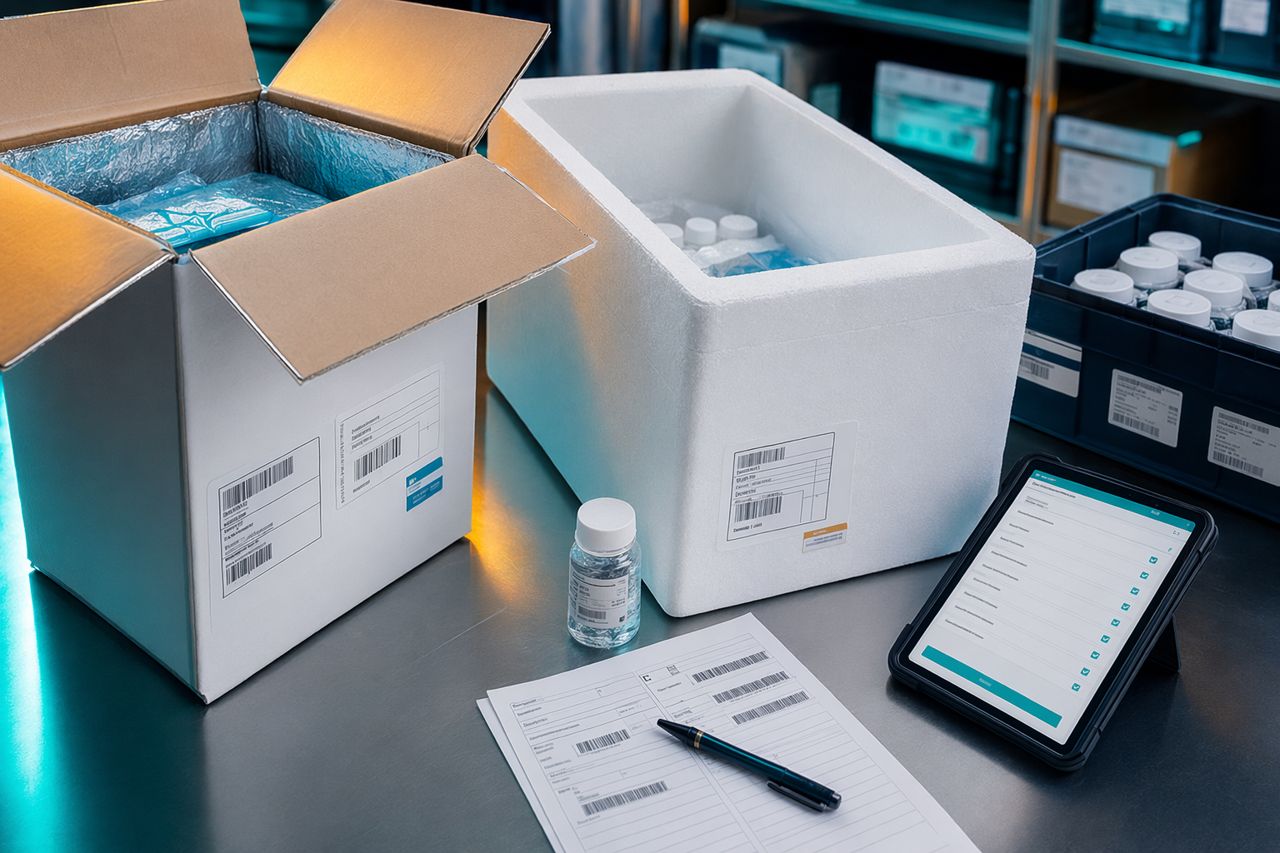
Cold-Chain Decisions for IVD Raw Materials and Finished Reagents
Temperature control is not only a logistics topic. For diagnostic reagent manufacturers, it is part of raw material risk management, QC release planning, and supplier qualification.
Sensitive enzymes, blockers, stabilizers, calibrators, and finished reagent systems can all be affected by poor storage decisions. A shipment may arrive on time and still create avoidable risk if the receiving team cannot verify exposure history, packaging condition, or material identity quickly.
Vitreline supports manufacturers that need bulk enzyme supply with lot consistency, documentation, and change-control support. This article outlines practical cold-chain decisions for teams qualifying raw materials and moving finished diagnostic reagents through controlled storage and distribution.
{{faceless_explainer_video: cold-chain-decisions-ivd-raw-materials}}
Start with material risk, not a default temperature label
A cold-chain plan should reflect how each material behaves in your process and finished reagent format.
Typical planning inputs include:
- Stated storage condition from the supplier specification
- Known sensitivity to heat, freeze-thaw exposure, light, or agitation
- Packaging format and headspace considerations
- Expected hold time before production use
- QC release timing and sampling workflow
- Inventory turnover and safety stock policy
- Downstream impact if the material is placed on hold
Not every raw material needs the same level of cold-chain control. Some materials require frozen storage. Others may be stable under refrigerated conditions. Finished reagents may have additional constraints once enzymes, buffers, salts, preservatives, and stabilizers are combined.
The key decision is not only the setpoint. It is whether the full workflow can keep the material within the approved state from dispatch to receipt, quarantine, release, and production use.
Warehouse zoning should match operational reality
Cold storage fails most often at process boundaries. Doors open. Pallets wait in staging. Labels are checked at ambient temperature. Samples are pulled without a defined maximum handling window.
A controlled warehouse layout reduces these weak points.
Useful cold-chain zones
- Inbound quarantine: For received materials awaiting document review, inspection, and QC decision.
- Released raw material storage: For approved lots available to production planning.
- Sampling area: For controlled opening, sub-sampling, and resealing where applicable.
- Finished reagent storage: For released goods requiring defined temperature conditions.
- Outbound staging: For packed shipments awaiting carrier pickup.
- Deviation hold area: For lots under review after an excursion, document mismatch, or packaging concern.
Zoning also supports traceability. Materials should not move from quarantine to released inventory without a documented status change. Finished reagents should not enter outbound staging until packaging, shipper configuration, and dispatch window are aligned.
Shipment qualification is a purchasing decision as much as a logistics decision
Procurement teams often evaluate price, lead time, and minimum order quantity. For IVD raw materials, shipment performance belongs in the same evaluation.
A qualified shipment approach should answer specific questions:
- Can the packaging configuration protect the material under expected transit conditions?
- Is the route compatible with the material risk profile?
- Are seasonal temperature profiles considered?
- Is the carrier service level appropriate for the hold time?
- Are temperature indicators or data loggers used where risk justifies them?
- Are excursion review responsibilities defined before shipment?
For a bulk enzyme supplier for diagnostic reagent manufacturing, shipping qualification is part of supply reliability. The enzyme lot may meet specification at release, but the manufacturer still needs confidence that the received material supports production use.
Vitreline aligns packaging, documentation, and dispatch planning to the customer requirement. The objective is simple: fewer receiving surprises and faster disposition.
Receiving checks should be fast, defined, and evidence-based
Receiving is the first quality gate at your site. It should confirm that the shipment is the expected material, in the expected condition, with the expected records.
Recommended receiving checks
- Verify product name, lot number, quantity, and container count against the purchase order.
- Inspect shipper condition before unpacking.
- Record arrival time and receiving temperature condition where required.
- Review temperature indicator or logger status, if included.
- Confirm that certificate of analysis, safety documentation, and packing documentation are present or available.
- Check container integrity, closure condition, and labeling.
- Move material to the correct quarantine or storage zone without delay.
- Escalate mismatches, excursions, or damaged packaging before release.
Speed matters. A well-trained receiving team can protect material quality and reduce production delays. The process should be clear enough to run the same way on a busy receiving dock and during a critical replenishment shipment.
Documentation must support supplier qualification
Cold-chain control is difficult to defend without records. Documentation should show what was shipped, how it was packed, which lot was supplied, and how exceptions are handled.
For enzyme raw materials, common documentation expectations include:
- Certificate of analysis for the supplied lot
- Product specification or agreed quality attributes
- Safety data documentation
- Country of origin and manufacturing site information where required
- Allergen, animal-origin, or regulatory statements where applicable
- Change-control notification commitments
- Shelf-life or retest guidance
- Packaging and storage instructions
Documentation is not administrative overhead. It is part of batch record readiness, supplier qualification, and audit response.
Finished reagents need a separate cold-chain view
Finished diagnostic reagents are not simply raw materials in new packaging. Once formulated, the risk profile can change.
Manufacturers should define whether the finished reagent is more sensitive to:
- Temperature cycling
- Light exposure
- Prolonged ambient staging
- Container orientation
- Headspace and closure integrity
- Transportation vibration
- Time out of controlled storage during kitting or labeling
This matters for release planning. A finished reagent lot may pass QC, but poor outbound staging or unqualified shipment can create avoidable customer complaints, investigations, and replacement costs.
Build cold-chain decisions into purchasing and planning
Cold-chain reliability improves when commercial and technical teams work from the same assumptions.
Procurement should know:
- Standard lead time and dispatch days
- Available pack sizes and container formats
- Shelf-life or retest expectations
- Temperature-controlled shipping options
- Documentation lead time
- Change-control process
- Lot reservation options for continuity
Quality and manufacturing should know:
- How incoming lots are identified and released
- How deviations are escalated
- Whether material can be sampled without extended exposure
- How inventory is rotated
- What replacement or re-shipment path applies if a cold-chain failure is confirmed
When these decisions are made early, receiving becomes faster and production planning becomes more stable.
What to ask an enzyme supplier before you place a bulk order
For sensitive enzyme raw materials, supplier qualification should include direct cold-chain questions.
Use this checklist during sourcing:
- What storage condition is specified for the material?
- What packaging options are available for bulk supply?
- How are shipments packed for seasonal or long-route risk?
- What records are provided with each lot?
- How are lot numbers and container labels controlled?
- What is the process for temperature excursion review?
- What change notifications are provided for manufacturing site, process, specification, or packaging changes?
- Can lots be reserved or scheduled against forecast demand?
- What lead time should be planned for repeat supply?
- Who supports quality, documentation, and procurement questions after order placement?
The best answers are specific. They show how the supplier protects continuity, not only how the material performs at release.
Vitreline support for controlled IVD enzyme supply
Vitreline supplies enzymes for diagnostic reagent manufacturers that need consistency, traceable documentation, and procurement-ready communication. We support bulk supply discussions with attention to storage, shipment planning, lot continuity, and change-control expectations.
Our role is to help your team qualify enzyme raw materials with less ambiguity. That includes clear documentation, realistic lead-time discussion, and technical alignment before materials enter your production schedule.
If you are evaluating an enzyme for an IVD reagent program, use the on-site form to request a quote. Share your target enzyme, quantity range, storage requirements, documentation needs, and expected timeline. Vitreline will respond with a supply-focused quotation path for your team.